
RESEARCH PAPER
Exploring Pathways to Teaching and Cultivating Human Values in Grade 7
Lady Irwin College, University of Delhi, New Delhi, India
Corresponding author: hiyachadha03@gmail.com
ABSTRACT
The study examines the effectiveness of value education strategies among Grade 7 students using the JoyfulTalisman philosophical framework on human values through action research. Fifty-two students in grade seven from a section were selected. The five pillars of the JoyfulTalisman philosophy were taught through a variety of methods, including guided meditation, web of connections, reflective drawing, film-based discussions, classroom clean-ups, joy box initiatives, gratitude cards and group performances. A pre-test and a post-test were used to analyse students’ conceptual understanding of the topic; later, student observations and reflections showcased behavioural change. The findings showed that kindness, empathy, cooperation and volunteerism have improved. Responsibility was still growing. Collaborative efforts and experiential learning made value education impactful, enabling students to apply values in their daily lives.
Keywords: Value Education, Human Values, Experiential Learning, Adolescents, Social-Emotional Learning, Behavioural Change
Adolescents’ social environment in the current time is marked by increasing stress levels, competitiveness among each other and rising tensions in relationships. Shrivastava and Bhat (2024) report that the new generation youth focus on fulfilling material pursuits, ready to sacrifice all their values, even lacking understanding of what these values mean. Value-based education is crucial for promoting respect for elders, character, empathy, social justice and each person’s holistic development, according to the National Education Policy (NEP, 2020).
Values give life direction, leading to contentment and serenity. The goal of education has been limited by modernisation; results and efficiency are now prioritised over the development of self-aware individuals. An education lacking values leads to inner unrest and social disharmony (Gandhi, 1948). To become responsible citizens, value-based education is necessary to transform students not only academically but also socially and ethically.
Adolescence is a critical developmental stage when identity, attitudes and moral reasoning solidify (NCERT, 2005; Nimi & Radhakrishnan, 2019). Early value education interventions during adolescence have an impact on prosocial behaviour, empathy and cooperation (Subramanian 2020; UNICEF 2018). Therefore, middle school classrooms are crucial for nurturing reflective, dialogic and experiential activities.
For individual well-being and collective coexistence, human values such as compassion, responsibility, nonviolence and service are essential (Chakraborty & Chakraborty, 2014). This idea is the foundation of the JoyfulTalisman philosophy (Kundu & Shah, 2024). It is rooted in Gandhian ethics and inspired by Mahatma Gandhi’s Talisman, which promote:
- Turning Inwards
- Human Interdependence
- Nonviolent Footprints
- Solidarity Footprints
- Volunteerism.
The framework aligns with national policy perspectives which emphasise peace education and value-based learning. (NCF 2005; CBSE Value Education Manual 2012).
The activities based on the five pillars of JoyfulTalisman resulted in clear behavioural changes among grade seven students. Students were able to identify their feelings and practise composure by turning inwards. According to Raina (2017), mindfulness helps teenagers better control their emotions. Peer collaboration was enhanced by Human Interdependence activities, consistent with Subramanian’s (2020) findings that value-based tasks foster social bonding. Students learned to reflect and consider behavioural impact after the Nonviolent Footprints session. Volunteerism tasks, classroom cleaning and creating JoyBox increased kindness and willingness to help peers. The post-test results showed higher scores in kindness, cooperation and volunteerism. Empathy showed moderate improvement. Responsibility remained weak. Matched earlier research stating that adolescents require sustained practice to build accountability (NCERT 2005).
What is Action Research?
Action research is a professional tool that provides educators with strategies for improving their teaching practices via dialogue, collaborative inquiry and reflection. It is authentic and meaningful as it is conducted by an educator in his/her own teaching space. Action research helps teachers to “Pick up threads suggested in academic circles, and weave them in their own classroom” (Ferrance, 2000, p.13). Action Research is never a passive process; educators construct new knowledge while linking their prior knowledge.
Just problem-solving is not action research. Certain principles have to be followed, such as participatory, sharing, time-bounding, problem-solving, collaborative attitude, distributive leadership, openness, democratic environment and collaborative decision (Nazneen & Hossen, 2006; Anam & Rahman, 2006). When an educator systematically conducts a study, keeping this philosophy in mind, it is action research.
Therefore, action research is an ongoing process where educators reflect on their teaching. They utilise classroom observations and student feedback to guide decisions and take steps to improve learning.
It follows five stages:
- Identifying: The Specific classroom issue is determined.
- Planning: Goals and strategies are identified here.
- Implementing: Where planned actions are carried out.
- Observing: Impact on students is monitored.
- Reflecting: Outcomes are evaluated for effectiveness. Revised goals are carried if they fall short.
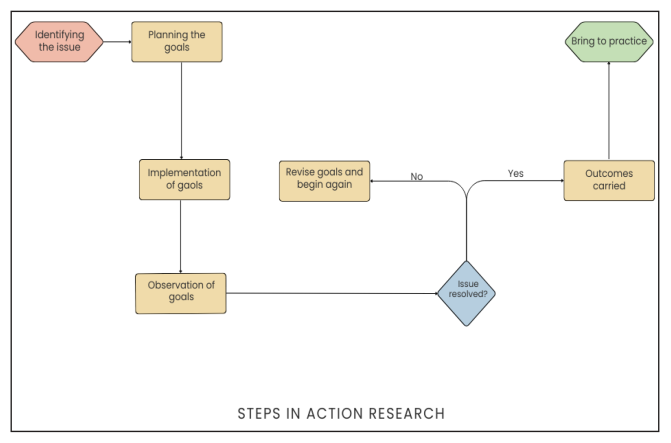
Action Research connects theory with practice. It helps educators grasp what is happening in their classrooms. Hensen (1996), as mentioned by Hine (2013), states that the focus of action research is to help educators gain new knowledge relevant to their classrooms, promote reflective teaching and thinking, broaden educators’ pedagogical skills, empower educators in their work, promote openness to new ideas and learning and give educators control over effective pedagogical practices.
Objective of the Study
To study the effectiveness of value-education activities in developing core human values among Class 7 students by integrating the philosophy of JoyfulTalisman.
Hypothesis
The JoyfulTalisman reflective activities help Grade 7 students better understand and practice important human values.
Methodology
It is crucial to adopt a methodical approach for data collection to test the study’s hypothesis. An experimental approach within a single-group pre-test—post-test research design was used to examine the effectiveness of activity-based value education. Structured reflections and activities are carried out through pre-test and post-test scores, with classroom observations.
Sample
Fifty-two students from one section of the school’s grade seven were selected for a purposive sample.
Procedure
To assess students’ understanding of life skills and human values, an MCQ-based pre-test was administered. Standardised items for both the pre-test and post-test were selected to maintain reliability and validity. The difficulty level, time required, subtopics and questions covered were ensured. Activity-based sessions were implemented using the JoyfulTalisman Coursebook (Kundu & Shah, 2025). The content aligns with essential life skills such as empathy, cooperation, responsibility and kindness. Students participated in guided activities, reflection tasks and performing arts based on these value pillars. After the end of the session, a parallel MCQ post-test was administered. Results were then compiled to evaluate students’ experience.
Tool
To make the session engaging, various tools were utilised. Changes in students’ behaviour, responses and understanding were observed.
- MCQ Pre-test and Post-test were used to assess students’ understanding of life skills and human values before and after the activities.
- Activity and reflection worksheets matching the Joyful Talisman values were provided to students. These included weekly reflection tasks, problem-based cards for value-based scenarios and a worksheet to list strengths and weaknesses.
- A Kindness bingo sheet was used as a tool for tracking behaviour, allowing students to track their acts of kindness over a week.
- Web of yarn exercise to show how students maintain connections while having diverse personalities and tastes.
- A recording of guided meditation in the teacher’s voice was used as an audio aid to promote emotional regulation and mindfulness.
- Audio-visual aids to show how supportive versus discouraging environments affect students by playing selected scenes from the Bollywood film “Taare Zameen Par”.
- Performing arts sources like scripts, prompts and props used for skits, role-plays, storytelling and other performance-based value demonstrations.
Analysis and Interpretation
The analysis looks at how well an activity-based value education intervention using the JoyfulTalisman course-book worked. Pre-test and post-test measures based on the five value pillars were used to evaluate students’ comprehension of human values. The analysis takes into account student reflections and classroom observations to document behaviour, participation and changes in value application after the intervention.
Pre-Test Analysis
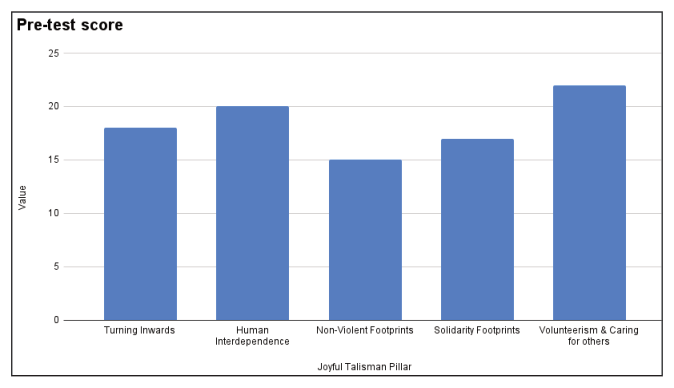
Students’ comprehension of human values was found to be uneven and limited across the five pillars in the MCQ-based pre-test. Volunteering and caring showed higher scores, suggesting a fundamental understanding of helpful behaviours. Lower scores in Turning Inwards, Solidarity Footprints and Nonviolent Footprints, on the other hand, indicated poor self-reflection, a weak sense of group responsibility and a lack of awareness of how one’s actions affect others. Overall, the pre-test results demonstrated the need for a structured value-based intervention but a shallow awareness of values.
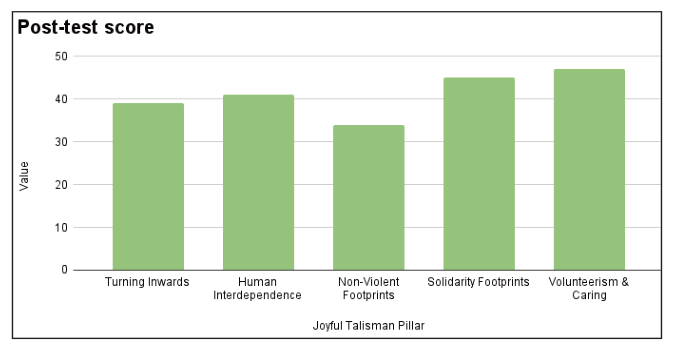
Post-Test Analysis
All five value pillars improved, according to the post-test results. The greatest improvements were seen in Volunteerism and Caring and Solidarity footprints, which demonstrated increased collaboration, empathy and group accountability. Additionally, Human Interdependence significantly improved, indicating a greater understanding of interconnectedness. Turning Inwards and Nonviolent Footprints showed significant improvement over pre-test levels but their scores stayed relatively low, indicating that self-regulatory and reflective values need ongoing reinforcement.
Comparative Analysis of Pre-Test and Post-Test Results
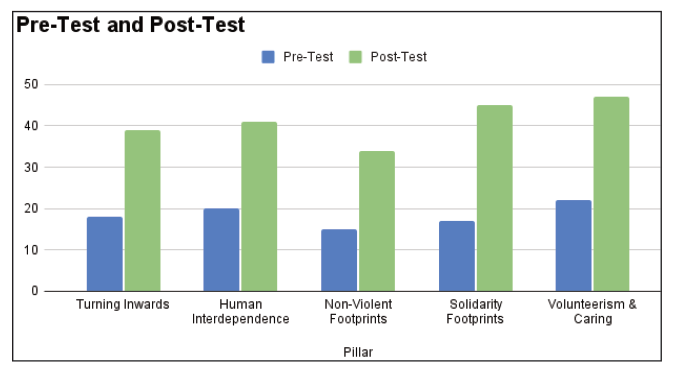
A comparison of pre-test and post-test results revealed remarkable growth of students’ knowledge and practice of human values throughout the five pillars of the JoyfulTalisman philosophical framework. Pre-test had limited and inconsistent awareness of values, whereas post-test demonstrated higher levels of conceptual clarity and behavioural application. This transition indicates that the students not just grasped the concept but applied the values in their lives.
Enhancements in the areas of Volunteerism and Caring and Solidarity Footprints were observed. The experiential activities of kindness tracking, problem-based value cards and group initiatives were the main reasons for these improvements. They made it easier for the students to assist their classmates by sharing food and stationery and becoming more involved in joint responsibilities. Students’ knowledge of Human Interdependence was enhanced through group activities of the web of connections and performances, which increased collaboration and understanding among the students.
Turning Inwards and Nonviolent Footprints depicted a moderate but noteworthy improvement, which was attributed to self-reflective practices of guided meditation, reflection worksheets and film-based discussions. Through these practices, students developed better awareness of their emotions and self and also became less judgmental in their interactions. Gradually and slowly at first, these values were transformed from the pre-test levels, denoting their internalisation.
Hence, the comparative study strengthens the assumption that the JoyfulTalisman philosophy is reflective and a great help to Grade 7 students to identify and practice fundamental human values, as indicated by the observable and improved post-test scores along with the positive behavioural changes in the classroom.
Conclusion
In the present action research, it was observed that a shift from traditional teaching instructions to reflective, experiential learning and value-based activities positively impacts students. The teacher felt that the action research experience had impacted them positively through:
- Commitment towards studying one’s own teaching for self-improvement and growth.
- Evaluation of own teaching practices through classroom research.
- Considering alternative perspectives and possibilities through conducting pre-test and post-test.
- Reflecting on their own teaching.
- Continued improvement of their own teaching and learning experience.
- Enhancement of pupil learning quality.
- The importance of alternative teaching and learning styles impacting student interest and participation in the school system.
A reflective teacher does not just deliver content but evaluates how teaching practices influence students’ understanding and behaviour.
The pre-test and post-test comparison results showcase consistent improvement across all five value pillars. It confirms that experiential and reflective teaching methods are much more effective than passive approaches to value education. Before the session, students showed uneven and limited understanding of values. While they had basic awareness of volunteering and caring, they lacked self-reflection, group responsibility and sensitivity toward the impact of their actions on others. This highlighted the need for a structured and engaging value education programme.
After the intervention, students demonstrated awareness and application of human values. The greatest improvements were observed in volunteerism and caring, solidarity and human interdependence. Activities such as kindness bingo, group tasks, role-play and the web of connections helped students collaborate, support one another and understand the importance of working together. These activities encouraged students to practice values in real-life classroom situations rather than only learning about them theoretically.
Moderate improvement was also seen in Turning Inwards and Nonviolent Footprints. Practices such as guided meditation, reflection worksheets and film-based discussions helped students become more aware of their emotions and reactions. However, the relatively lower scores suggest that these values require continuous practice and long-term reinforcement.
Values and attitudes cannot be developed effectively through instruction alone; they require active participation, reflection and lived experiences. Experiential and participatory learning approaches help students internalise values by connecting thoughts, emotions and actions (Kolb, 1984). Studies on value education also highlight that activities such as reflection, collaboration and service-based tasks lead to deeper moral understanding and behavioural change among adolescents (NCERT, 2005; Subramanian, 2020).
Cooperative learning, which involves students working together toward shared goals, has been shown to enhance social responsibility and mutual respect, as learners support both their own and their peers’ growth (Johnson, Johnson & Smith, 1991).
Action research enables teachers to critically examine and refine their instructional practices based on classroom evidence. Meyers and Rust (2003) describe action research as an essential activity of reflective teachers, allowing them to understand how changes in pedagogy influence student learning and behaviour. In the present study, the shift from conventional instruction to activity-based value education through the JoyfulTalisman philosophical framework resulted in improved student engagement, stronger social values and observable behavioural change. This supports the view that value education becomes meaningful and effective when students actively experience, reflect upon and practise values within their everyday classroom interactions.
Overall, the findings indicate that value education becomes more effective when taught through experiential, reflective and participatory methods. The Joyful Talisman philosophical framework proved to be a useful tool in helping students understand and practice core human values, as seen through improved post-test scores and positive behavioural changes in the classroom.
Through critical reflection on their own pedagogical practices and comprehension of value education, the research enabled the teacher to take an active role in the teaching-learning process. The activity-based sessions using the JoyfulTalisman course-book allowed the instructor to watch, evaluate and modify instructions to promote cooperation, kindness, empathy, responsibility, and volunteerism among students in Grade 7. This process increased the teacher’s confidence in their capacity to create meaningful learning opportunities, enhance their instructional strategies and impact students’ comprehension and application of human values in the classroom.
Generative AI Declaration
The author(s) confirm that there was no use of artificial intelligence (AI)-assisted technology for assisting in the writing or editing of the manuscript, and no images were manipulated using AI. The authors developed and verified all scientific content, data analysis, interpretation of results, and conclusions. The authors take full responsibility for the accuracy, integrity, and originality of the work presented, and no AI tool was listed as an author.
References
- Anam, S. and Rahman, M. 2006. Action research in education: Principles and practices. Academic Press.
Google Scholar - Central Board of Secondary Education. 2012. Value education manual. https://cbseacademic.nic.in
- Chakraborty, S. and Chakraborty, R. 2014. Human values and education. Sage Publications.
Google Scholar - Ferrance, E. 2000. Action research. Northeast and Islands Regional Educational Laboratory at Brown University. https://www.brown.edu/academics/education-alliance/sites/brown.edu.academics.education-alliance/files/publications/arprimer.pdf
- Gandhi, M.K. 1948. Education. Navajivan Publishing House.
Google Scholar - Hensen, S. 1996. Action research: Principles and practice. Falmer Press.
Google Scholar - Hine, G.S.C. 2013. The importance of action research in teacher education programs. Issues in Educational Research, 23(2): 151–163.
Google Scholar - Johnson, D.W., Johnson, R.T. and Smith, K.A. 1991. Cooperative learning: Increasing college faculty instructional productivity (ASHE-ERIC Higher Education Report No. 4). George Washington University.
Google Scholar - Kolb, D.A. 1984. Experiential learning: Experience as the source of learning and development. Prentice Hall.
Google Scholar - Kundu, Vedabhyas & Shah, Munazah. 2024. The JoyfulTalisman: Conversations on Human Values for a Joyful World. Naamak Publications.
Google Scholar - Kundu, Vedabhyas & Shah, Munazah. 2025. The JoyfulTalisman Coursebook on Human Values. Naamak Publications.
Google Scholar - Meyers, C. and Rust, F. 2003. The power of action research: A practical guide for educators. Corwin Press.
Google Scholar - National Council of Educational Research and Training. 2005. National curriculum framework 2005. https://ncert.nic.in
- Nazneen, S. and Hossen, M. 2006. Participatory action research for teacher development. Educational Action Research, 14(3): 401-412.
Google Scholar - Nimi, P. and Radhakrishnan, S. 2019. Adolescents and value-based education: Developing prosocial behaviour. Journal of Education and Human Values, 5(1): 23–35.
Google Scholar - Raina, R. 2017. Mindfulness and emotional regulation in adolescence. Sage Publications.
Google Scholar - Shrivastava, P. and Bhat, S. 2024. Materialism and value erosion in contemporary youth. International Journal of Social Sciences and Education, 12(2): 45–58.
Google Scholar - Subramanian, A. 2020. Value education and adolescent development. Academic Press.
Google Scholar - UNICEF. 2018. Education and adolescent well-being. https://www.unicef.org/education